Task:
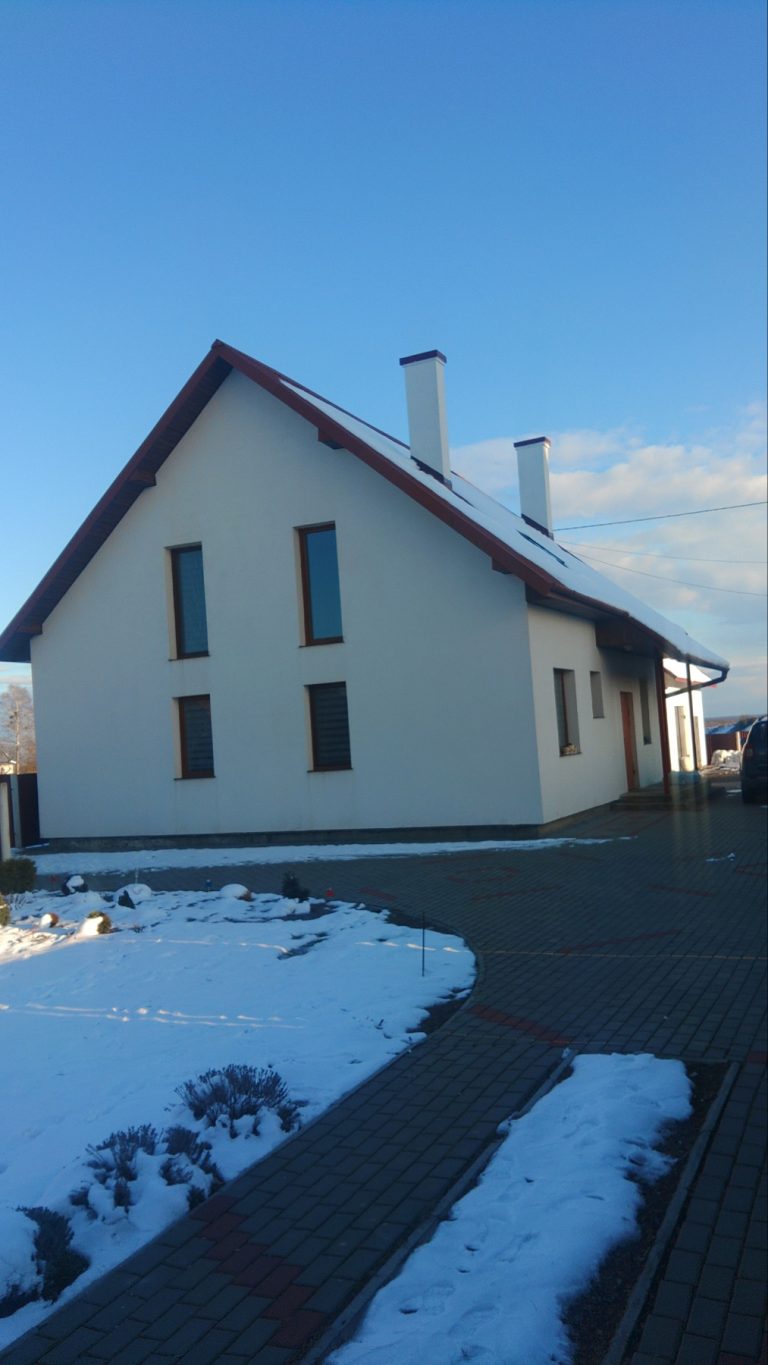
A resident of the village of Savenki contacted our company with a request to select equipment in order to reduce heating and hot water costs. The client has long begun to look for alternative and more environmentally friendly means of heating without losing their efficiency even at the lowest temperatures.
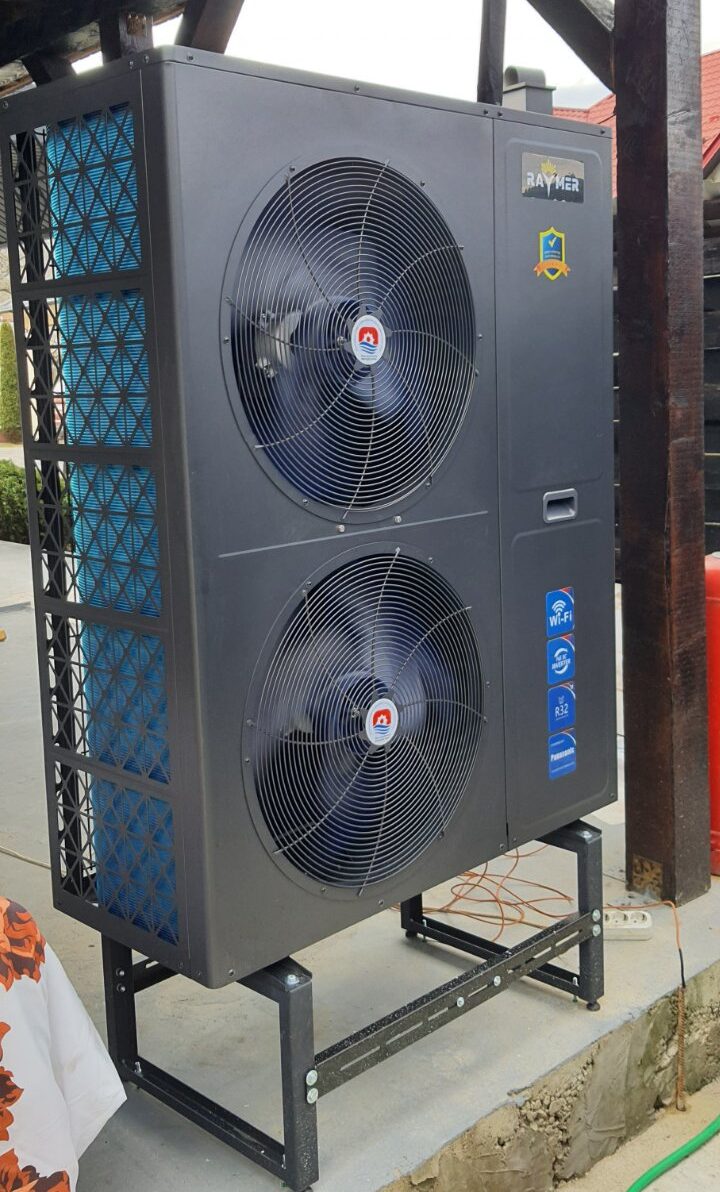
As a result of an analysis of the client’s capabilities and the ergonomics of the house, it was decided to install a geothermal heat pump Raymer RAY-10WW, which in 4-5 times more efficient than an electric boiler, which until now has been the main source of heating in the house.
Answer:
The main purpose of installing the Raymer RAY-10WW geothermal pump is to improve the energy efficiency of the home and create comfortable living conditions at minimal cost on a long-term basis.
Geothermal pump uses thermal energy from the earth, which significantly reduces dependence on external energy resources (electricity, gas) and allows you to significantly save on heating and cooling your home.
Compared to an electric boiler, which was already installed before, a ground source heat pump has a significantly higher efficiency factor (Efficiency) and produces at medium power 10 kW of thermal energy consumed 2,2 kW.
The pump was integrated into the hot water supply and “warm floor” system, which have already been pre-laid.
Scope of work completed
1. Analysis of the existing heating system
The beginning of any installation of a geothermal pump involves conducting a detailed analysis of the house's communications and the thermal properties of the house, adjacent territory and properties of the earth's surface, where the actual drilling will take place.
2. Well drilling
The installation of any geothermal pump first involves drilling wells for cold and hot water supply. The distance between these wells should be at least 15 m, for proper heating of the coolant.
 Drilling was carried out using special equipment, to reach layers of the earth's surface with a stable temperature, what is the main condition for the operation of a water-to-water heat pump.
3. Pump installation
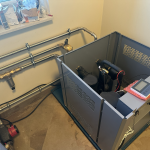
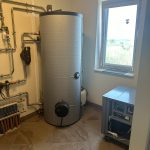
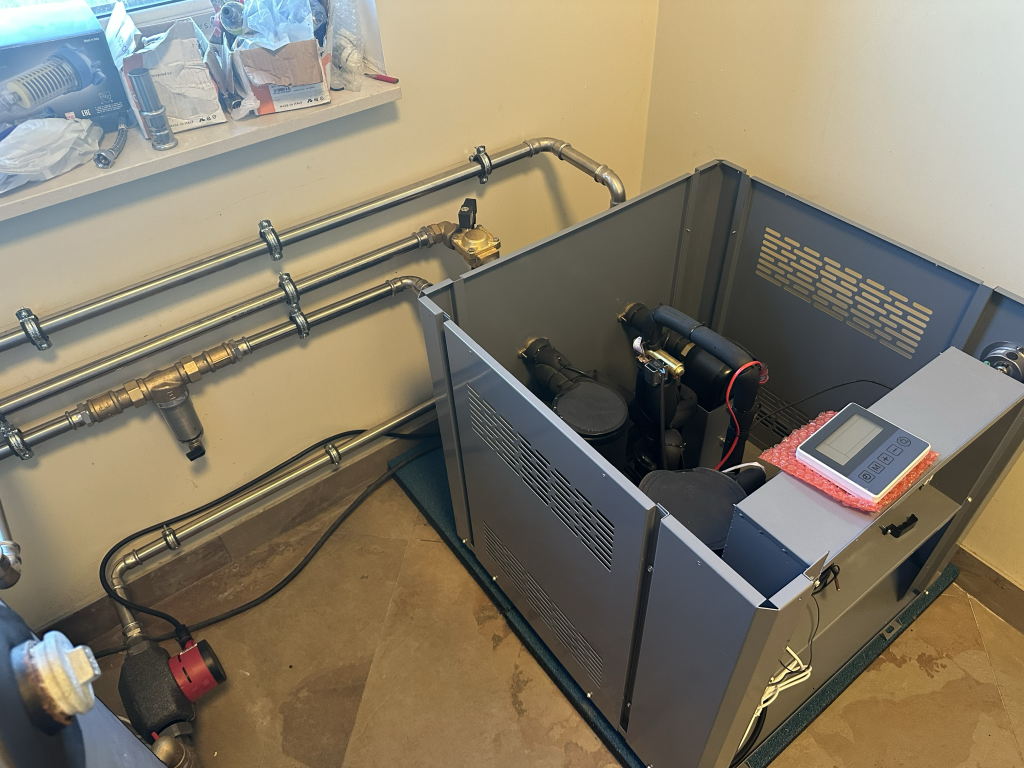
The heat pump unit was placed in the boiler room at an optimal distance from key system components, allowing easy access to connections, valves and the pump itself, simplifying maintenance and increasing the efficiency of the entire system.
It should be noted, that this heat pump already has a built-in shell-and-tube heat exchanger on the evaporator line, which is very resistant to dirt and does not require additional maintenance.
3. Connecting an indirect heating tank
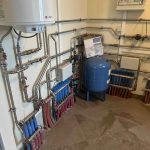
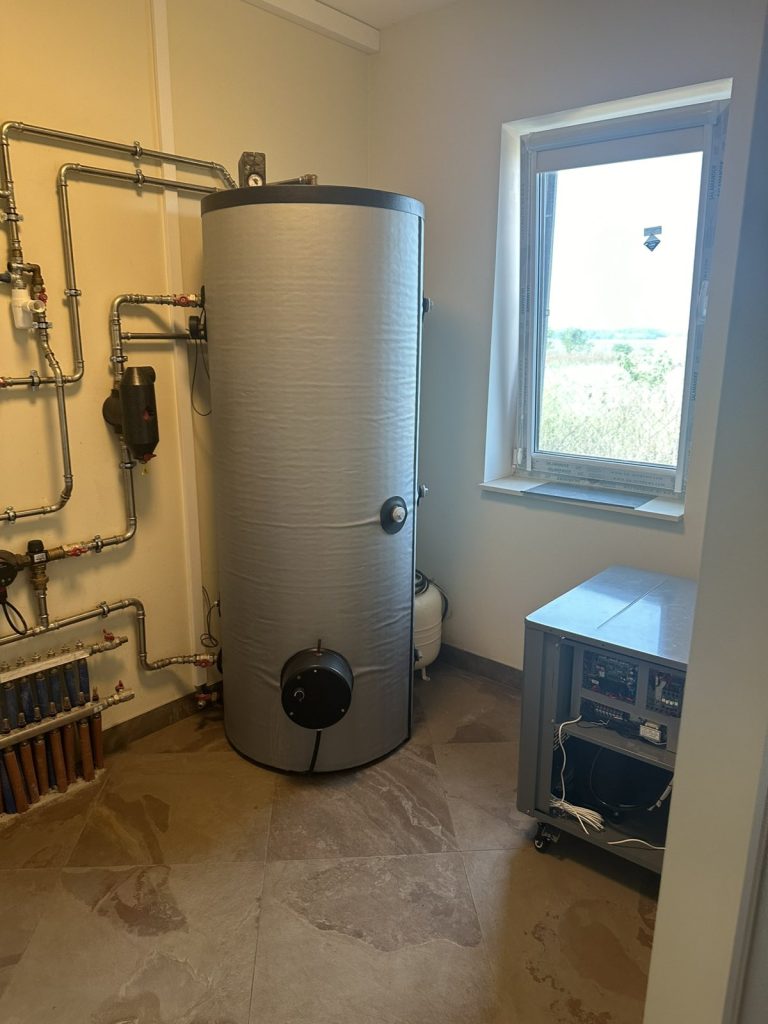 To provide hot water supply using a geothermal pump, an indirect heating tank is used.
The geothermal pump is connected to the tank through a heat exchanger, providing constant water heating. Hot coolant from the pump is supplied through the supply pipeline to the tank heat exchanger, after which the cooled coolant is returned back to the pump system through the return pipeline.
The control system of a geothermal pump is often configured like this, to give priority to water heating. It means, that when using a heating system and hot water supply at the same time, the pump directs heat first to heat the water in the tank.
4. Additional system components
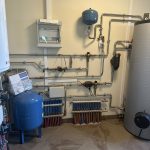
Circulation pump and three-way valve play a key role in the efficient operation of the geothermal system, ensuring proper distribution of coolant between heating and hot water supply.
Circulation pump responsible for maintaining a stable flow of coolant through the geothermal heating system. This ensures even heat distribution throughout the system, providing efficient space heating and water heating. Circulation pump ensures minimal heat loss, which increases the overall efficiency of the geothermal system and reduces energy consumption.
Connection diagram: The circulation pump is connected to the pipelines, connecting the geothermal pump to an indirect heating tank or heating system. Depending on operating mode, it ensures the movement of coolant through heat exchangers, contributing either to heating the room, or heating water.
Three-way valve serves for automatic distribution of coolant between different circuits, For example, heating and hot water supply. Thanks to it, you can switch coolant flows without stopping the system.
Many geothermal heating systems use the hot water priority principle.. A three-way valve in such a system ensures the supply of coolant first to heat the water in the tank, and after reaching the required temperature, switches it to space heating.
Connection diagram: The three-way valve is installed between the geothermal pump and the two main circuits – heating and water heating. When the system detects a need for hot water, the valve directs the coolant to the indirect heating tank. When hot water is not needed, the valve switches to the heating circuit, providing efficient heating of rooms.
Interaction between circulation pump and three-way valve:
- When is water heating required?, a three-way valve redirects the coolant flow to the indirect heating tank, and the circulation pump ensures a continuous flow through this circuit.
- After that, How will the water in the tank reach the set temperature?, three-way valve switches to heating circuit, and the circulation pump continues to move the coolant to heat the rooms.
This combination allows the geothermal system to flexibly and efficiently meet both heating needs, and in hot water.
5. Installation of expansion tank
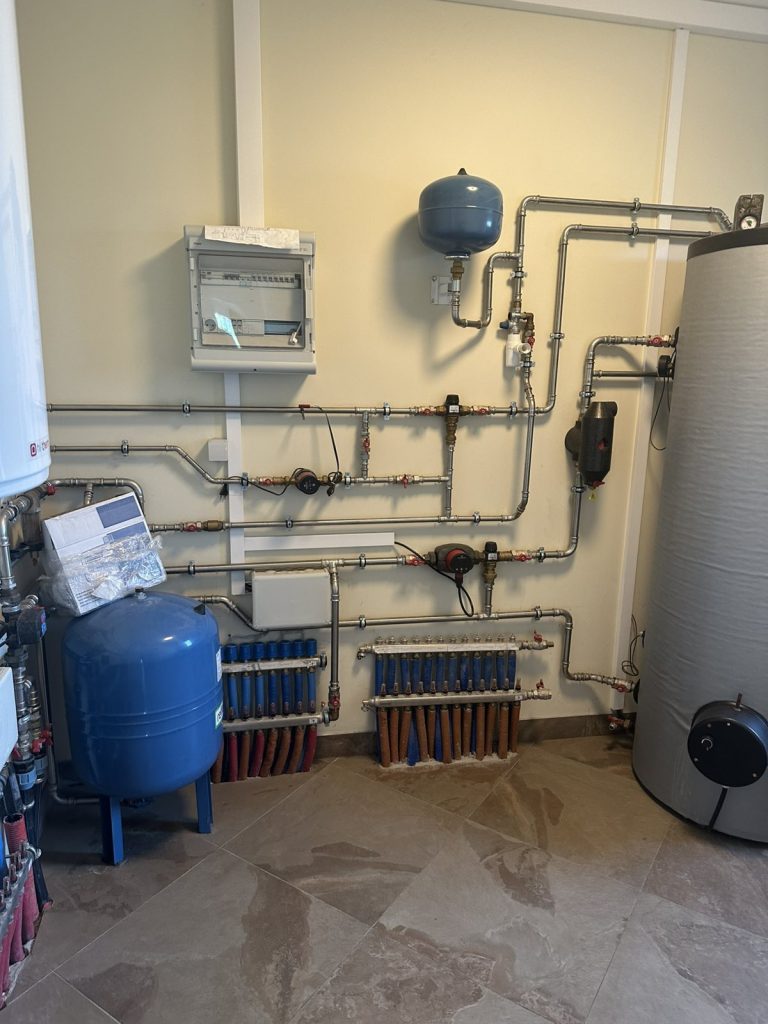 Geothermal system uses large volumes of coolant, since ground heat exchange circuits are involved. Therefore, a properly selected expansion tank is a critical element for stable operation of the system., ensuring its uninterrupted and safe operation for a long time.
Expansion tank performs an important function in a geothermal heat pump system, associated with compensation for changes in coolant volume during heating or cooling.
When the coolant in the system heats up, its volume increases, creating additional pressure in pipelines. The expansion tank accepts this additional volume of liquid, preventing system overpressure, which may damage pipes or other components.
Thanks to the expansion tank, System pressure remains stable even during temperature fluctuations. This contributes to the longevity of the equipment and efficient operation of the system. The tank helps avoid overloads due to sudden increases or decreases in pressure.
If there is a sudden change in temperature or the pump stops quickly, water hammer may occur – short-term, but intense increases in pressure. The expansion tank acts as a shock absorber, softening these shocks and protecting the system from damage.
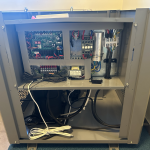
5. Installing a controller to monitor system performance
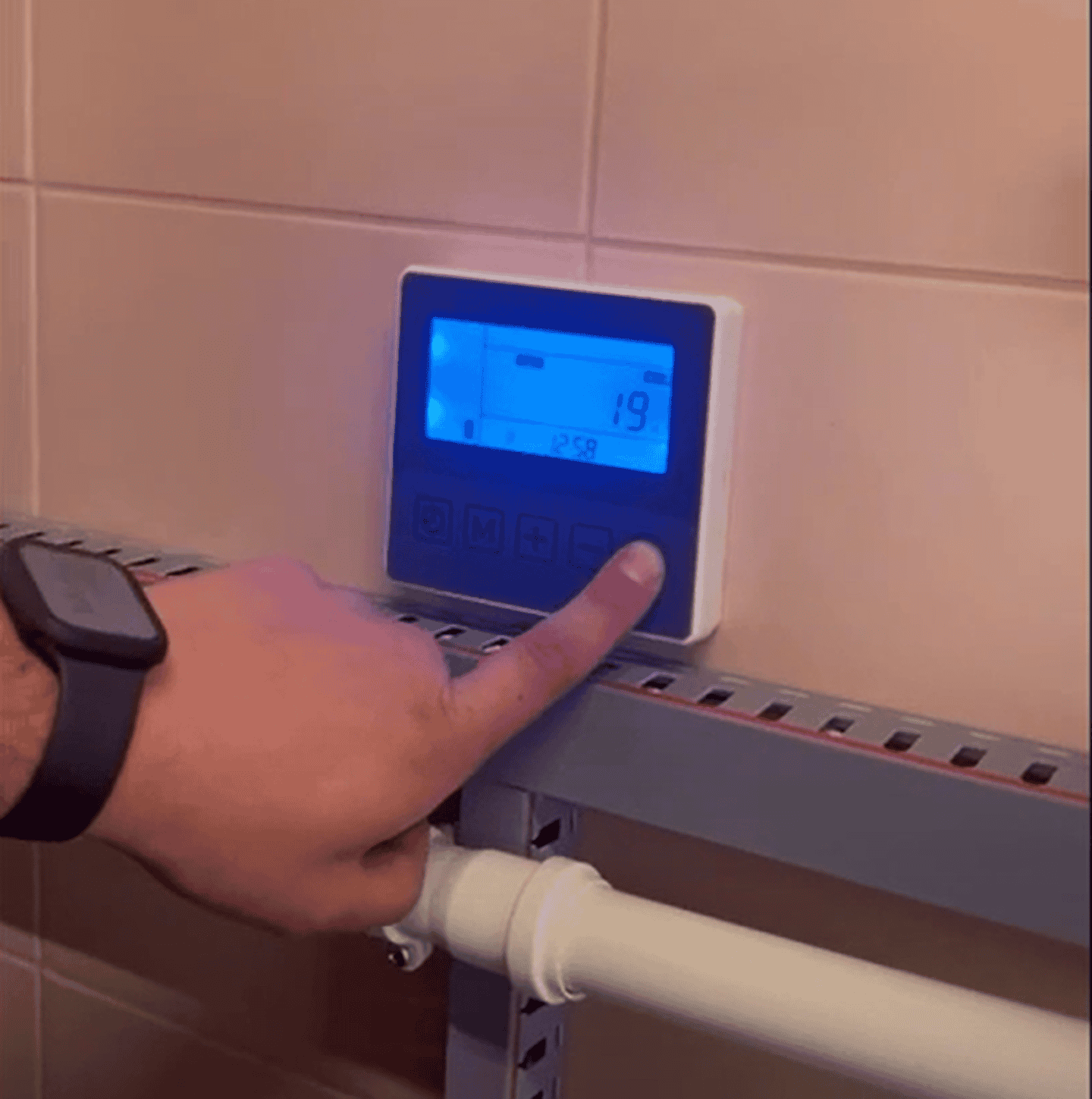 Installing a controller to monitor heating system performance is an important step, allowing to optimize its operation and provide comfortable conditions. The controller provides:
Temperature monitoring: Measures indoor and outdoor temperatures, which allows you to regulate the heating.
Mode management: Allows you to configure different operating modes of the system, such as automatic, energy saving or comfortable.
Data visualization: Shows system metrics on screen, which makes them easy to understand.
Performance Analysis: Collects energy consumption data, which helps identify opportunities to improve efficiency.
Problem Alert: Automatically informs about any problems in the system, which allows timely action to be taken.
Thus, installing a controller not only increases the efficiency of the heating system, but also ensures its reliability and ease of use.
Features and characteristics of soil (geothermal) heat pump Raymer RAY-10WW
The Raymer RAY-10WW ground source heat pump is a modern solution for heating private homes. The main technical characteristics of this pump allow it to operate with high efficiency at low operating costs.
Power and efficiency:
Thermal power of Raymer RAY-10WW is 10 kW, which provides efficient heating of houses up to 110 sq.m. Thanks to inverter technology, the pump automatically adjusts its power depending on the heat demand, which allows to significantly reduce energy consumption.
Environmental friendliness:
Raymer RAY-10WW uses earth energy, what is a renewable source. This significantly reduces CO2 emissions compared to traditional gas or electric boilers, making it an environmentally friendly heating solution.
Reliability and durability:
Raymer RAY-10WW heat pump is made of high quality materials, ensuring long-term operation. The pump housing is resistant to corrosion and mechanical damage, and inverter technology reduces component wear, which increases the service life of the system.
Possibility of working with hot water supply:
Raymer RAY-10WW can be used for more than just heating, but also for hot water supply. Integration with an indirect heating tank allows you to provide your home with sufficient hot water, even with high requirements for its consumption.
Automation of work:
The heat pump is equipped with a modern control system, allowing to automate the process of heating and hot water supply. The control system allows you to adjust the temperature in different areas of the house, providing maximum comfort for residents.
Safety and reliability:
Expansion tank, connected to the system, ensures pressure stability, which is an important aspect for the safety and durability of the entire heating system.
Benefits for the client after installing the Raymer RAY-10WW heat pump:
After installing a geothermal heat pump, the client will receive a number of significant benefits:
Significant savings on energy consumption:
Geothermal heat pumps use energy from the soil, which allows you to get more heat with less energy consumption. This provides up to 75% savings on heating bills compared to traditional electric or gas systems.
Independence from gas and price fluctuations:
Using energy from the soil, the client becomes less dependent on the gas market and its price fluctuations. This creates more predictable and stable heating costs in the long term.
Comfort in any season:
A geothermal pump provides more than just heating in winter, but also effective cooling in summer, creating an optimal microclimate in the house throughout the year. Also, the hot water supply system works smoothly and is energy efficient..
Environmental Safety:
Geothermal systems use renewable energy and significantly reduce CO2 emissions, making them one of the most environmentally friendly home heating and air conditioning options.
Durability and reliability:
Geothermal pumps have a long service life, because they operate without wear due to external climatic conditions. It means, that the customer can count on minimal maintenance and stable performance for decades.
Increase in property value:
Investing in a geothermal pump increases the value of your home in the real estate market. Energy efficient solutions are attractive to potential buyers, as they guarantee low operating costs in the future.
Stable operation in any conditions:
Geothermal systems work effectively at any outdoor temperature, because the soil at depth maintains a stable temperature. This allows the system to operate without performance degradation even in the coldest winter months.
Minimal noise and aesthetics:
Unlike traditional systems, Geothermal pumps are very quiet, and the external components of the system are hidden underground, that does not violate the aesthetics of the yard or house.
Automated control:
Modern geothermal systems are equipped with intelligent controllers, that allow you to easily control your heating and cooling from anywhere via your smartphone or other devices. This simplifies operation and allows you to customize the system to suit your personal needs..
Installation payback:
Thanks to significant energy savings, investment in a geothermal pump pays off quickly. Over time, the customer can receive a full return on investment and continue to enjoy a nearly free heating and cooling system.
Thus, installation of geothermal heat pump Raymer RAY-10WW is the solution, which not only increases the comfort and economic benefit of the client, but also contributes to environmental conservation and energy independence.