Task for the project
House in the village of Volchinets, Ivano-Frankivsk region, Previously heated by an electric boiler. The owner decided to replace it with a more effective heat pump Raymer RAY-15DS1-EVI To reduce electricity costs and increase energy efficiency.
The main tasks:
-
Installation and connection of the outer heat pump unit.
-
Installation of a hydromodulus in the boiler room.
-
Connection to the existing heating and hot water supply system.
-
Settings and test launch of the system.
The project is carried out by the owner independently, in compliance with all the necessary requirements for stable and efficient operation of equipment.
Why exactly the Raymer Ray-15DS1-EVI heat pump?
The owner chose Raymer Ray-15DS1-EVI due to its high efficiency, energy conservation and reliability in work at low temperatures.
The main advantages:
-
EVI technology -provides stable operation even at -25 ° C, What is important for Ukrainian climate.
-
Power 15 kW - Enough for heating the house and hot water supply.
-
Economical - consumes less electricity compared to electric boiler, Reducing heating costs.
-
Versatility - works for heating, hot water and even cooling in the summer.
-
Reliable brand - Raymer has good reviews and has established itself as high -quality equipment.
This choice allows you to get a comfortable microclimate in the house with minimal electricity costs.
Stages of the work
Since the owner decided to independently install the heat pump, Installation was carried out under the clear leadership of our engineers. This made it possible to ensure the correct connection of all components, The system compliance with the technical requirements and the reliable operation of the equipment.
Engineers helped with:
🔹 Designing the connection scheme and choosing the optimal installation location.
🔹 Installation quality control – correct connection of the freon circuit, Electricians and hydraulics.
🔹 check and setting up the system before starting.
Thanks to this approach, the owner received a qualitative result, saving funds and confidence in the correct operation of the heat pump.
1. Installation of the outer block of the heat pump Raymer Ray-15DS1-EVI
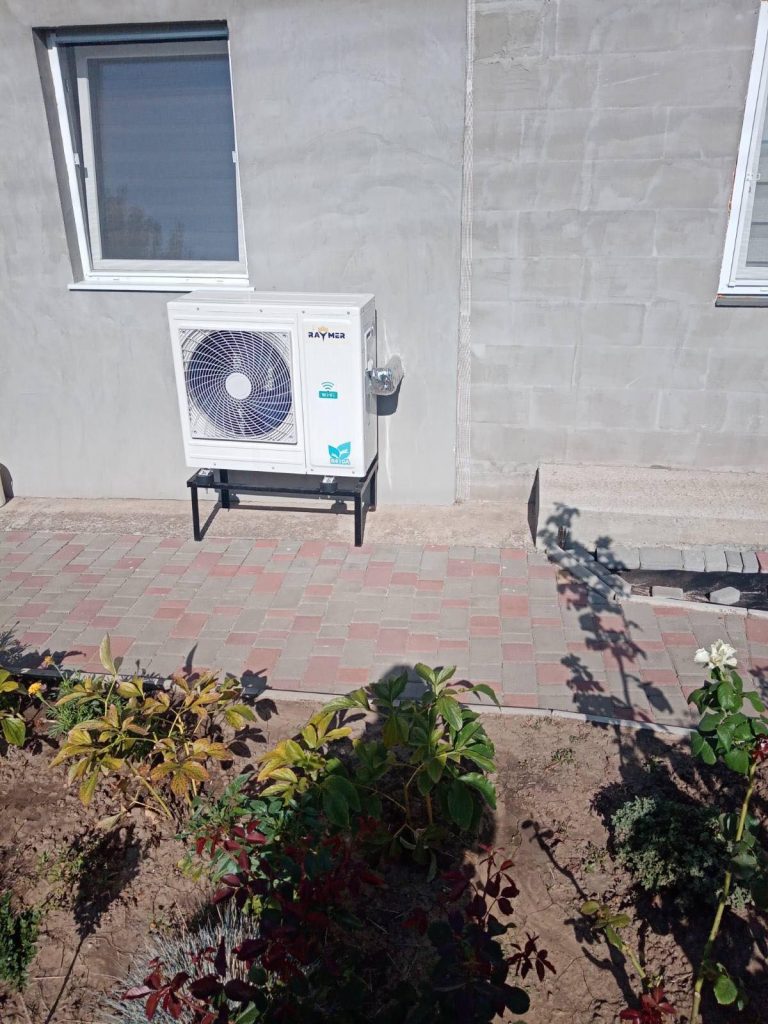
The outer block of the heat pump was installed on a special metal frame, which is fixed on a concrete base. This approach provides:
Stability of the structure - the block does not contact directly with the ground, what prevents his subsidence and contact with moisture.
Optimal ventilation - sufficient space for air circulation contributes to the efficient operation of the fan.
Vibration protection - used dampers to reduce noise and vibration during operation.
Freon trunk were laid for the connection, electric cable and drainage, which are neatly insulated and protected.
Thanks to the proper installation, the outer unit will provide stable and efficient operation of the heat pump throughout the year.
2. Установка гидромодуля теплового насоса Raymer
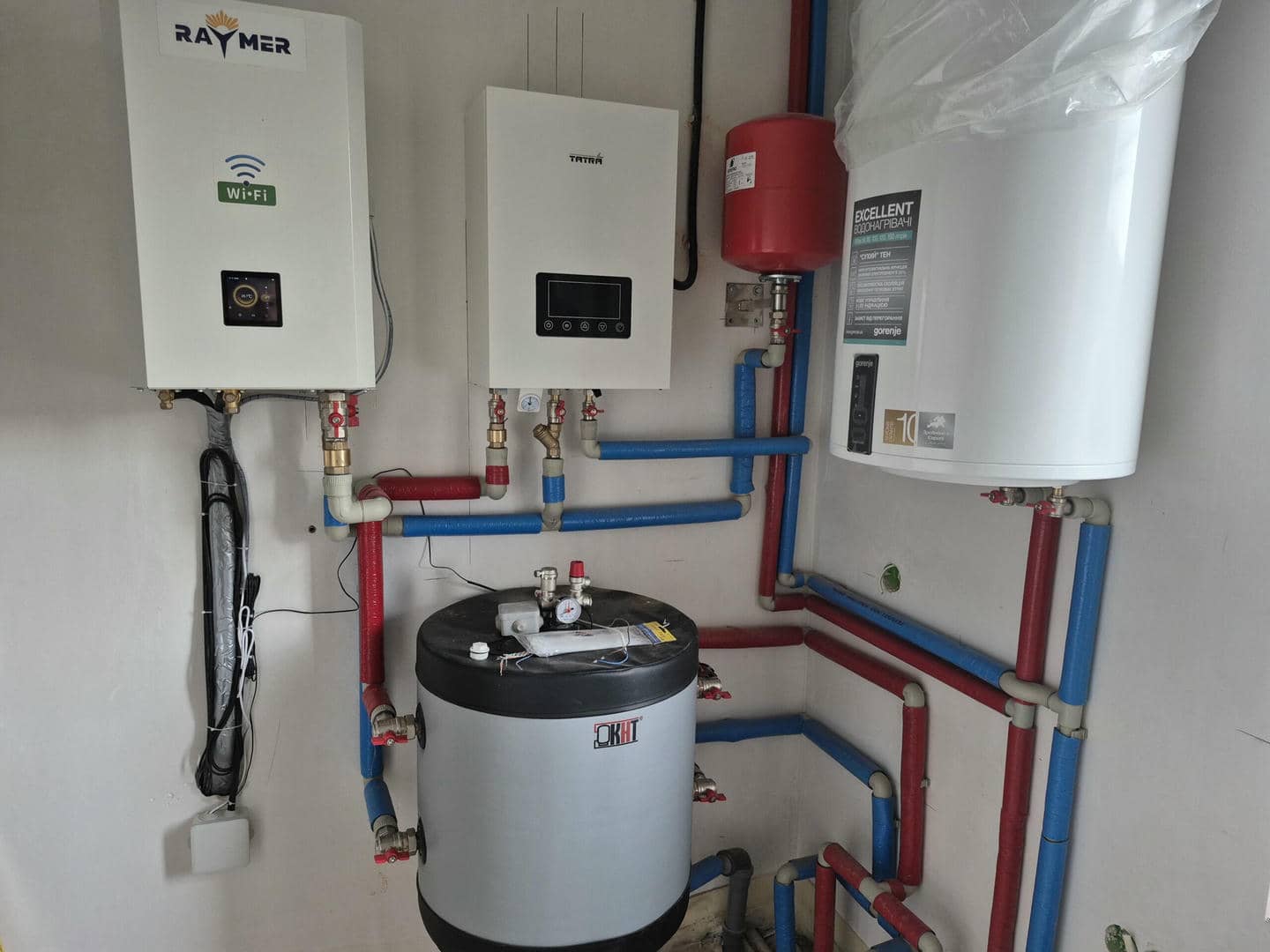
The hydraulic engine was mounted on a wall in a technical room next to an electric coil. This location allows you to optimize the connection to the existing heating system and provides convenient access for maintenance. All communications are connected in accordance with security standards and efficient operation of the system.
Basic installation steps:
Installation of the hydraulic module - the device is securely fixed on the wall near the electric boiler, which simplifies the integration of both systems.
Connection to pipelines - hot and cold water are summed up in accordance with the direction of the flow (Hot pipe is isolated by red material, Cold – blue).
Freon line - hermetically insulated and displayed through the wall to the outer block.
Electric connection - carried out in accordance with safety requirements, which ensures stable operation of the hydraulic module and interaction with the electric boiler.
Checking and testing - after the completion of the installation, all the connections were checked, setting parameters and test launch.
Due to the proper installation, the hydraulic engine works stably, effectively transferring heat to the heating system of the house, and the location near the electric boiler makes it possible to use both heat sources if necessary.
3. Integration with an existing system
In this project, the Raymer Ray-15DS1-EVI Heating pump was integrated into an existing heating and hot water system, which consisted of an electric boiler, hot water boiler and buffer capacity. The installation of the heat pump made it possible to significantly increase the energy efficiency of the system, reducing electricity costs.
The hydraulic engine of the heat pump is installed near the electric boiler
The hydraulic pump of the heat pump is connected parallel to the electric boiler. It means, that both heat sources can work independently or together. In case of severe frosts, electric boots can automatically turn on to maintain a comfortable temperature. The three -way valves used provide automatic switching between heat sources, And the control system regulates their operation depending on the needs.
Buffer capacity as a stabilizer of the system
Buffer container accumulates heat, which allows you to reduce the number of inclusions and offs of the compressor of the heat pump, extending the service life. It also provides uniform distribution of heat in the heating system. The buffer is connected between the heat pump and the consumers of the heat, and temperature sensors control his work.
Hot water boiler receives heating from the heat pump
Before installing the heat pump, the boiler heated the water only with an electric heating water. Now the main heating occurs due to the heat pump, which significantly reduces the costs of hot water supply. Connection is carried out through a coil in a boiler, through which the coolant circulates. If the water temperature is insufficient, automatically turns on the electric heating element.
The hydraulic diagram of pipelines
To ensure stable work of all heat consumers, The system is equipped with locking and balancing taps for regulating flows. The heat pump is connected to existing pipelines with minimal changes.
Expande tank to compensate for pressure drops
The expansion tank prevents equipment damage due to expansion of the coolant during heating and helps maintain stable pressure in the system. It is installed at the top of the system and equipped with a safety valve.
4. Installation of voltage stabilizers to protect equipment
Due to possible voltage fluctuations in the mains, To protect the heat pump, electric boiler and other important equipment was Simistor voltage stabilizer Stabex Hn VS-5kva has been installed.
The main goal of installing a stabilizer is to protect sensitive electrical appliances from voltage drops, which can lead to their incorrect work or failure.
Heat pump and electric boiler have complex electronics and compressor, which are especially sensitive to tension surges.
Type: Simistor voltage stabilizer;
Power: 5 kva (5000 And), which is enough to ensure the operation of the heat pump and related equipment;
Working range of input voltage: 140-260 AT;
Stabilized output voltage: 220В±4%;
Protection: from high and low voltage, short circuit, overload.
The stabilizer is installed in the technical room, On the wall next to the power supply shield of the heating system. This location provides:
-
Easy access for service
-
Minimum wiring voltage losses
-
Protection against mechanical damage and moisture
The input of the stabilizer is connected directly to the mains of the house. The output of the stabilizer is connected to a separate power circuit, Feeding thermal pump, electric boiler and circulation pumps. A circuit breaker was used to additional protection of the stabilizer from overload
Thanks stabilizer, The voltage in the heat supply system is maintained at 220V ± 4%, which guarantees stable operation of the heat pump, electric boiler and other equipment. This avoids emergency shutdowns, overheating of electronics and extends the service life of the devices.
Features of the Raymer heat pump RAY-15DS1-EVI 220 AT
Energy Saving: The heat pump provides up to 80% saving energy by using heat from the environment, which reduces costs compared to traditional heating methods.
Ecological cleanliness: The use of R410A freon makes the pump environmentally friendly, reducing CO2 emissions and helping to combat climate change.
Silent operation: The pump runs quietly, which allows it to be used in residential areas without discomfort. Built-in cooling function creates a comfortable microclimate in summer.
Inverter technology: The pump automatically adjusts power according to demand, providing stable heating and energy efficiency.
EVI technology: Increases pump efficiency in low temperature environments by injecting additional steam during compression, which improves performance in winter conditions.
Remote access via Wi-Fi: The ability to control the pump and monitor its operation via a smartphone or computer from anywhere with Internet access.
Reliability and durability: High quality materials and modern technologies ensure a long service life, which is confirmed by positive user reviews about stability and comfort.
Benefits for the client when replacing an electric boiler with a heat pump?
Customer, which replaces an electric boiler with a heat pump, receives several significant benefits:
Reduced energy costs: Heat pumps typically use less electricity to produce the same amount of heat, which can lead to significant reductions in heating costs.
Environmental friendliness: Using a heat pump reduces CO2 emissions, because it draws energy from the environment, making it a more environmentally friendly solution.
Versatility: Heat pumps can do more than just heat a room, but also provide cooling in summer and hot water supply, making them a universal solution for comfort throughout the year.
Improved comfort: Heat pump systems provide more stable temperatures and better control, which increases the overall comfort in the home.
Less maintenance: Heat pumps generally require less maintenance than electric boilers, which reduces maintenance costs.
Durability: Heat pumps have a longer service life compared to electric boilers, which reduces the need to replace equipment.
All in all, Replacing an electric boiler with a heat pump can significantly improve energy efficiency, reduce costs, improve comfort and have a positive impact on the environment.