Tasks the project
The main goal of this project was to ensure a comfortable climate in the house using modern equipment, allows minimizing energy costs and increase the level of autonomy of heating.
Previously, the house was heated using an electric boiler, which will now remain a backup source of heating. The cost of heating the boiler was too high, Therefore, the customer began to look for alternative heating sources to save resources.
Analysis and selection of equipment
When choosing a thermal pump for autonomous heating of the house, it is important to consider as the technical characteristics of the equipment, and its effectiveness in real operating conditions. After analyzing the available options, the Raymer Ray-10DS2-EVI model was chosen, which optimally complies with the needs of the customer according to performance parameters, economy and reliability. Comparing the heating costs with an electric boiler and a heat pump detected, that the cost of heating with an electric boiler in 4 times higher, than a heat pump.
Key advantages Raymer Ray-10DS2-EVI:
EVI technology (Enhanced Vapor Injection) - provides stable operation at low temperatures, which is critical for regions with cold climate.
Power 10 kW - sufficient for heating a private house of medium size.
energy efficiency - The high coefficient COP can significantly reduce heating costs.
Inverter technology - provides smooth power adjustment, which increases the life of the equipment and improves its efficiency.
Intellectual management through Wi-Fi - allows you to control and configure the pump operation remotely through a mobile application.
Compatibility with buffer capacity and DIS - the ability to connect additional tanks for the effective accumulation of heat and hot water.
Justification of the choice:
Heat pump Raymer RAY-10DS2-EVI was chosen due to its ability to work effectively at low temperatures, which is an important factor for the installation region. Its performance and reliability provide stable heating with minimal energy consumption.
Besides, the possibility of remote control and flexibility in connecting to other elements of the system (buffer capacity, DIS boiler) made this option the most convenient and effective for the implementation of autonomous heating.
Stages of work execution
The customer decided to perform installation on his own, guided by the recommendations of our engineers. The process included the installation and connection of all the necessary components: heat pump, hydraulic module, buffer capacity, Hot water supply tank, voltage stabilizer and pipeline system.
 1. Outdoor unit installation
Installation of the external unit of the heat pump Raymer Ray-15DS1-EVI was completed by the customer on his own. The block is installed on a reliable base of concrete blocks, which ensures its stability and reduces the risk of vibrations during operation. Connection of heat -insulated pipelines is made through the wall of the house, which allows minimizing thermal losses and provides a neat type of installation.
The necessary space for servicing the unit is also provided. An important stage of installation was the correct connection of the drainage system and checking all compounds for tightness. Due to the correct placement and fixation, The external unit operates reliably and ensures the effective operation of the heating system.
2. Installation of the indoor unit

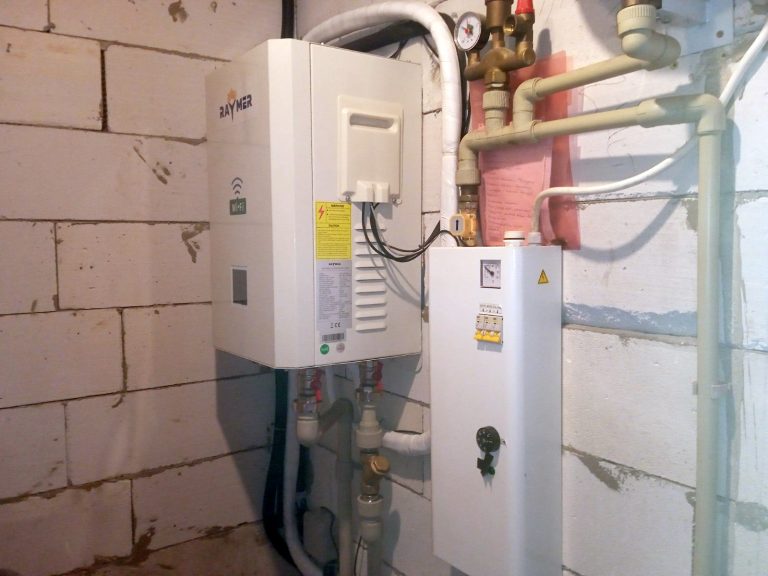
Raymer hydraulic engine is installed on the wall next to the Tenko electric boiler, which allows you to effectively use the space in the boiler room. Installation is performed independently, Taking into account the optimal connection scheme to the Baku-Hybrid, providing hot water supply and maintenance of temperature in the heating system.
Connection to pipelines is made using polypropylene and metal -plastic pipes using shut -off valves for convenient maintenance. The hydraulic engine is integrated into the reverse and direct circuit system, and also connected to the mechanical cleaning filter, which helps to protect the heat exchanger from possible pollution.
Thanks to the well -thought -out installation scheme, the system works stably, ensuring effective temperature control in the house.
4. Installation of the Raymer IMP drive tank 60 L
 The installation of the buffer capacity was carried out for the accumulation and uniform distribution of heat in the heating system and hot water supply, which reduces the number of inclusions and offs of the heat pump and ensures stable equipment.
The container is connected to the hydromodulus through the feed and reverse pipelines, and for the possibility of service, ball valves are installed.
In the lower part, a drain crane is provided for devastation if necessary.
Electric connection is made in compliance with security, Temperature sensors are connected to the controller of the hydraulic engine. Installation is made independently taking into account all the necessary requirements for effective and reliable operation.
Advantages of using the heat pump in front
The use of a heat pump instead of an electric boiler has a number of significant advantages, among which the main ones are economy, Efficiency and environmental friendliness. Consider in more detail, Why the heat pump is the best choice for heating a house.
1. Electricity saving and cost reduction
The main advantage of the heat pump is High energy efficiency.
- The electric boiler converts 1 KW of electricity c 1 kW of heat (Efficiency ≈ 99%).
- Thermal pump uses electricity not for heat generation, and for its transfer from air or earth, Therefore, for 1 kW of electricity it can produce 4-5 kW of heat (Efficiency or Cop = 3-5).
- This allows you to reduce heating costs in 4-5 once Compared to electric boiler.
for example, If an electric boom is required for heating a house 5000 kWh per month, then the heat pump at Cop = 4 consumes everything 1250 kwt ·.
2. Possibility of cooling in summer
Electric boiler is used exclusively for heating, While most thermal pumps have The function of the reverse, which allows you to cool the room in the summer, Replacing air conditioning.
3. Environmental friendliness and reduction of Co₂ emissions
Since the heat pump uses Environmental heat (out of thin air, soil or water), but does not burn fuel, He:
- Reduces Co₂ emissions Compared to power plants, which produce electricity for electric boilers.
- Promotes transition to renewable energy, especially in combination with solar panels.
4. Operation at low temperatures
Modern thermal pumps with EVI technology (Ejector injection of steam) They can work effectively Even at -30 ° C., Providing comfortable heating even in cold regions.
5. Automation and ease of management
- The heat pump has Automatic temperature control And it can work according to the specified graphs, which reduces energy consumption.
- Management is possible Remotely through Wi-Fi, which simplifies configuration and control.
- Electric shows are less automated, And their work often requires manual intervention.
6. Safety and durability
- Lack of open heating element reduces the risk of fire and overheating.
- The average service life thermal pump - 15-25 years, Whereas electric boiler usually serves 8-12 years.
- Less wear out parts mean Low need for maintenance.
7. Combining with other energy sources
The heat pump works well in combination with:
- Solar panels - which allows you to get almost zero costs for electricity.
- Solid fuel boilers - to increase autonomy.
- Buffer containers - for greater stability of the system.
Conclusion
The heat pump is an innovative solution, which allows reduce heating costs, increase comfort and automate the system. Unlike an electric boiler, He provides Multifunctionality, Economy and environmental friendliness, What makes him the best choice for a modern house.
If an electric boiler is already installed in the house, The transition to a heat pump is Reasonable investment, which will pay off due to the saving of electricity already for 4-5 years.