

Tanks to the heat pump: what are they and why are they needed
Human, who for the first time deals with the topic of using alternative heat sources, asked many questions ranging from “Which heat pump to choose?" and "What and how to install?" to "Shouldn't I change the heating type in my parents' house??». Topics of interest to clients will be addressed in one way or another in this article.. But it's worth starting, after all, from the most fundamental question.

What is a heat pump?
Heat pump - is a device, which takes energy from a low-calorie heat source. Such a source could be:
-
outside air;
-
geothermal springs;
-
water from natural reservoirs;
-
soil and groundwater;
-
air ventilation emissions.
At first glance, this is impossible - receiving free energy literally out of thin air suggests a miracle has happened.. The second law of thermodynamics comes to mind: the impossibility of transferring heat from a cold body to a warmer one.
But there is no magic - heat pumps consume the mechanical energy supplied to them at the input and produce thermal energy at the output.
How does a heat pump work??
The theoretical basis for the operation of such devices is the reverse Carnot cycle. It is possible with the correct operation of each heat conversion cycle.

The energy received from the source is transferred through the system using a refrigerant (liquids, which boils at subzero temperatures). This is possible due to the operation of the air compressor, which creates zones of expansion and compression of the working fluid.

When receiving energy from outside, the refrigerant boils and turns into steam. Being in a gaseous state, it is compressed in the compressor. At the outlet of the compressor, the refrigerant gas has increased pressure and temperature. In the condenser the steam turns back into liquid form, transferring heat to the heating system.
As a result, the refrigerant becomes twice as cold, but his blood pressure remains low. To promote him to working level, fluid passes through the expander (TRV). Now normalized parameters allow the refrigerant to enter the evaporator and go through the cycle again. Thus, a closed cycle does not produce any emissions - “fuel” does not burn, and is used repeatedly and repeatedly.
Which heat pump is better?

There are no universal solutions, but any of the systems using HP is more profitable in the long term.
Important! The operating period of such a device reaches 50 years, which, in comparison with the 20-year operating period of boiler equipment, significantly reduces its cost in terms of 1 year.
More detailed calculations are shown in the graph.

The advantages of TN include:
-
simplicity of design and operation;
-
economic benefit;
-
reliability of materials;
-
safety in use.
VT-based systems are environmentally friendly. There is no place for the use of open fire and emissions from fuel combustion. On electrical safety, vibrations and noise they do not differ from many other household appliances.
The electrical content of such devices allows you to connect them to an application via Wi-Fi and control the temperature conditions in the room from your phone. This makes it possible to adjust the temperature half an hour or an hour before returning home, and also set up different modes depending on the time of day.
Each type of heat pump has its own advantages and limitations.. for example, for underground, you need to install tens of meters of pipe underground. This also requires space, and additional installation costs. Devices water-water require drilling the ground and the proximity of groundwater to the surface. But at the same time, both of these types are capable of delivering more stable power., since they do not depend on the ambient temperature, like pumps air-water. However, they are the most popular, because they do not require any special installation conditions and are cheaper.
What elements are needed for the HP system “air-water”?
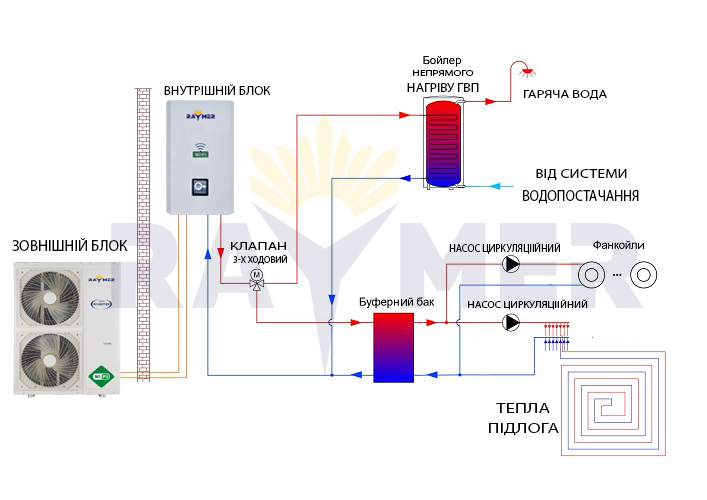
For correct operation the entire heating system, in addition to the basic apparatus itself, required:
-
plumbing junction;
-
pump group;
-
indirect heating DHW tank;
-
storage buffer.

Required tank No. 1
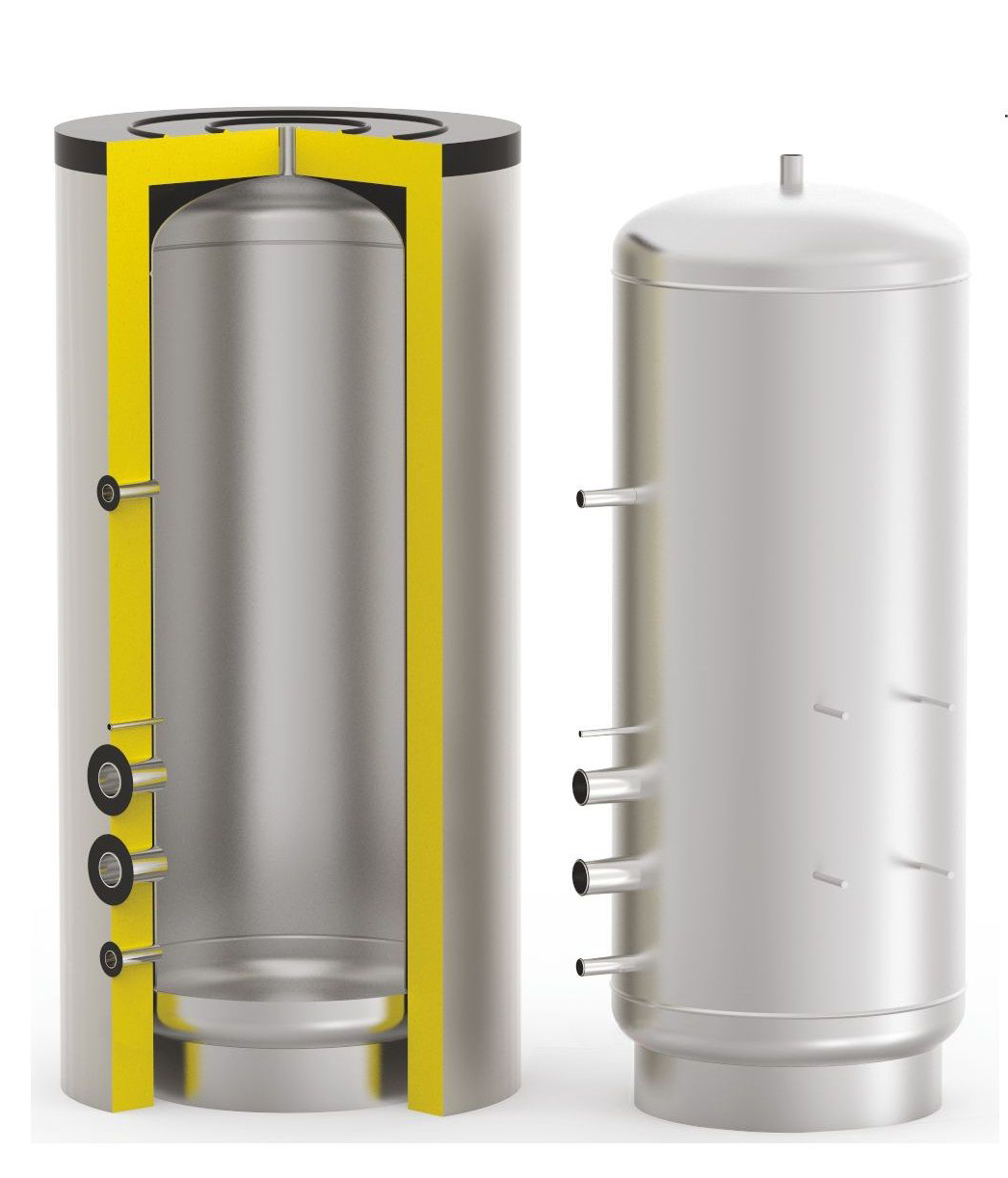
Buffer tank is an optional component, which can be connected in parallel, combined or sequentially. It can be placed after the HP condenser and act as a coolant storage tank. That is, it allows you to store the thermal energy of the refrigerant in case, if the generation of new heat stops or becomes unstable due to unfavorable air temperature conditions.
Important! Connecting a buffer tank significantly reduces the number of starts of the heat pump, which extends its service life and saves electrical energy. Due to these circumstances, equipment manufacturers require a buffer tank, as mandatory.
Buffer capacity (or battery) performs several important functions:
-
Temperature stabilization. The buffer tank helps balance uneven heat inputs due to non-uniform energy input from the air. This ensures a more stable temperature in the heating or hot water system.
-
Increased efficiency. Buffer capacity can smooth out load fluctuations, allowing the heat pump to operate under more stable conditions. This reduces the frequency of switching on/off the device and increases its operating efficiency.
-
Improved comfort. By stabilizing the temperature and more evenly distributing heat, the buffer tank helps create more comfortable indoor conditions.
-
Protection TN. Buffer capacity prevents frequent switching on and off, which can reduce equipment wear.

How to calculate buffer displacement?
Opinions regarding the selection of container volume are divided - the numbers start from 10 liters per kW of power and go up to 60 liter per kW. To be fair, you can immediately notice, that in both cases the pump will work. But incorrect calculation will greatly reduce the positive qualities of each specific heating system. Therefore, you need to approach the calculation wisely.
The general calculation scheme may include:
-
Definition of consumption. It is important to know the amount of heat demand of the room, including the required heat for heating and hot water supply. It is also worth paying attention to factors, affecting heat losses (insulation, climatic conditions).
-
Temperature selection. Temperature range needs to be determined, which one you want to support.
-
RCalculating the volume of the buffer tank using the formula:
Q = ηm ⋅ c ⋅ DT , Where
\(Q) - thermal energy (in joules);
\(m) – coolant mass (in kg);
\(c) – specific heat capacity of the coolant (in J/(kg·°C));
\(\D T) – temperature change (in °C);
\(\and) – system efficiency. Convert thermal energy to volume, knowing the density of the coolant.
Specific parameters may vary depending on the heat pump model, heating system design and other factors. Maybe, It is also worth consulting with professionals Reimer, to get more accurate recommendations for your specific case. Our installation and operation experience proves, that the scheme works most efficiently based on 40 liter of buffer per kW of power TN.
If power outages are likely, consider the following:: a very large buffer capacity will negatively affect the operation of the heat pump. Therefore, we recommend sticking to the minimum volumes indicated in the tables..
For monoblock types it is recommended:
OPTIMUM RATIO OF HEAT PUMP POWER AND BUFFER TANK CAPACITY
FOR RAYMER MONOBLOCK TYPE:
FOR RAYMER HEAT PUMPS SPLIT SYSTEMS:
You can select the device yourself, but it's better to contact the experts Reimer.
Required tank No. 2
Other required capacity is DHW tank. An indirect hot water tank is a container without a heating element, which is used to heat water. To increase the temperature of the water inside expansion tank of the domestic hot water system uses energy, transmitted from the pump.
Important! Indirect heating tanks for gas boilers are not suitable for a system with a heat pump. To guarantee the correct operation of heat pumps, very expanded and oversized heat exchangers are needed with an area of from 2.5 sq.m.. and higher.
Main Components indirect heating DHW tank usually include:

- heat exchanger, which ensures effective heat exchange between the coolant and water.
- Insulation, which minimizes heat loss and maintains a high water temperature inside the container.
- Thermostat and sensors, which are used to control fluid parameters. They provide the proper hot water temperature according to the user's needs.
Here are some causes, Why worth putting expansion hot water tank:
- Increased efficiency – the resulting heat is not lost, and accumulates in water.
- Energy Saving – the container does not require additional heating elements, therefore does not consume electricity.
- Long service life – insulation and lack of direct contact with the heating element make the tank less vulnerable to malfunctions.
How to choose a hot water tank?
A game called “TOHow to calculate a tank for hot water supply?” may end the rule "the more, all the better", but still When selecting, it is important to maintain optimal volume and power. It is worth considering the number of consumers, and temperature requirements.
You can use the following hint:
- Assess your hot water needs – how many people and how they plan to use it. Pay attention to the amount of water consumed for each method of use. (shower, cooking food, washing, etc.).
- Calculate volume, while applying safety and redundancy factors, to take into account possible consumption peaks.
- Determine the desired hot water temperature. This may depend on your preferences and standards for the capabilities of a particular VT..
- Select tank taking into account calculations, requirements, regulations and standards.
For Raymer heat pumps there are certain recommended selection schemes.
MONO-BLOCK TYPE:
SPLIT SYSTEM:
| Model TN Raymer | |||
| DHWP 150L, area of the built-in heat exchanger from 2,25 sq.m.. | DHWP 200L, area of the built-in heat exchanger from 3 sq.m.. | DHWP 250L, area of the built-in heat exchanger from 3,75 sq.m.. | DHWP 300L, area of the built-in heat exchanger from 4,50 sq.m.. |
| Split RAY-10DS1-EVI (220V) | Split RAY-15DS1-EVI (220V) | Split RAY-18DS1-EVI (220V) | Split RAY-24DS1-EVI (380V) |
| Split RAY-13DS1-EVI (220V) | Split RAY-15DS1-EVI (380V) | Split RAY-18DS1-EVI (380V) | Split RAY-32DS1-EVI (380V) |
| Split RAY-24DS1-EVI (380V) | |||
What are heat pump tanks made of??
Worth paying attention, What Most buffer tanks and hot water tanks are made of stainless steel. This is due to the advantages of products made from it:
- Corrosion resistance. Stainless steel does not oxidize well and does not react to aggressive environments. This is especially important in heat pump systems, where various coolants are present, water and chemical additives.
- Durability. Stainless steel materials are generally highly durable, including resistance to mechanical and temperature influences. This makes them durable and, hence, economically profitable.
- Hygiene. Stainless steel is easy to clean and provides hygienic storage conditions for coolant. This is important to maintain high water quality and prevent the development of bacteria or other microorganisms.
- High thermal conductivity. Stainless steel conducts heat well, effectively transferring it in the VT cycle.
- Minimal heat loss. Stainless steel buffer tanks are often well insulated, which helps minimize heat loss and maintain a stable temperature inside the tank.
- Environmental friendliness. Stainless steel is an environmentally friendly material, which can be recycled.
For high-quality selection of both types of heat pump tanks It is worth using the help of experienced heating and water supply engineers. Specialists Reimer will be able to take into account the features of your system and help you choose the optimal solution.
Correct installation of all devices will help your home be energy independent!


