

Selection of a heat pump “air-water”: Monobloc or Split system?
If you plan to install a heat pump “air-water”, you can choose between a monobloc and a split system. Which makes these two options a bargain in terms of price, space, functionality and noise level? What are the main differences and which option should you bet on - monobloc or split pumps? Let's consider this in more detail.
There are two main types of structures on the market, which are usually called monobloc and split system. Here are their features and benefits. Both systems work according to the same principle, using the laws of thermodynamics to produce heat, that is, the compression and expansion of the refrigerant gas, which emits heat or cold during these processes. A heat pump can not only heat, but also to cool.
The main differences between Monobloc and Split system
Monobloc
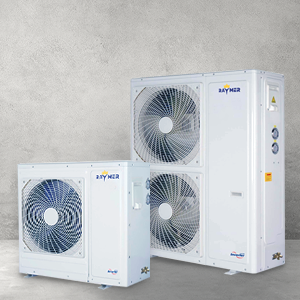
– Construction: All components (fan, evaporator, compressor, expansion valve and condenser) located in one block.
– Installation: The monoblock is usually installed outdoors.
– Tightness: All connections inside the monoblock are made at the factory, which ensures high tightness of the system and minimizes the risk of refrigerant leakage.
– Ease of installation: Does not require special tools or complicated installation, all the necessary components are already assembled.
Split system

– Construction: The system is divided into two blocks: external unit (fan, evaporator, compressor, expansion valve) and indoor unit (condenser, circulation pump, controls).
– Installation: It is necessary to lay pipelines for the refrigerant between the blocks, which requires a high qualification of the installer. The greater the distance between the blocks, the more difficult the installation.
– Noise level: The indoor unit works more quietly, since the noise sources are in the outdoor unit.
– Efficiency: High efficiency with proper installation, but depends on the quality of the connections and the distance between the blocks.
DISADVANTAGES OF THE MONO-BLOCK:
Among the disadvantages of monoblock pumps, it is worth noting risk of coolant freezing at the outlet from monobloc at low temperatures. This can happen due to a prolonged lack of power supply, example, during fan outages or accidents at power plants.
In the highway, which connects the monoblock and distribution devices, water circulates. Water, unlike freon, freezes at 0°C, although thanks to the insulation of the trunk with rubber, freezing can occur at -7°C.
To avoid this problem, RAYMER recommends using it in MONOBLOCKS in the system 35 % alcohol solution of ethyl alcohol.
COMPARATIVE TABLE
| PARAMETER | MONOBLOCK SYSTEM | SPLIT SYSTEM |
| Number of blocks | 1 | 2 |
| SOR (coefficient) | There are no differences | There are no differences |
| The maximum length of the trunk (from the buffer to the external unit) | to 5 meters | to 20 meters |
| Additional circulation pump in the boiler room | SO | NO |
| Takes place in the boiler room of the house | NO | SO |
| Ease of installation | SO | NO |
| Additional tools for installation | NO | SO |
| COST | LOWER | HIGHER |
| The need for an alcohol solution instead of water in the system | SO | NO |
Monobloc or Split?
Both types of heat pumps work on the same principle, but have different designs and installation methods. In a monobloc pump, the entire system is assembled and tested at the factory, which ensures stable operation and high reliability. Split systems require qualified installation, as part of the installation is done on site. Their effectiveness depends on the correctness of the connections and the distance between the blocks. But the water in the monoblock heating system can freeze,when the lights are turned off in winter.

Visnovok
Both types of heat pumps have their advantages.
Monoblocs provide easier installation and reliability, since the whole system is manufactured at the factory. But there is a risk of defrosting, therefore, you need to pour an alcohol solution.
Split systems allow more flexible placement of components and ensure a lower noise level inside the room. The choice depends on the specific conditions of your home and your installation and maintenance priorities.


